Notes from “(Un-)Virtual ‘Materials’,” a workshop by Melanie Cieśliński and Polina Filippova at Untameable Futures (u+, 21 -22 October 2026).
Where does a new idea begin: on paper, or on a screen? That was the first question Melanie Cieśliński and Polina Filippova asked the room during their workshop. The encounter between the two creatives had begun with this discussion, and it was quite natural for them to revive the flow of their shared reflections for the participants. Even if their practices are very different in terms of media and tools, they found shared meaning. The session set out to explore what “materials” can mean for each person and how changing our relationship to a material can change how we imagine futures.
Two ways of meeting a material
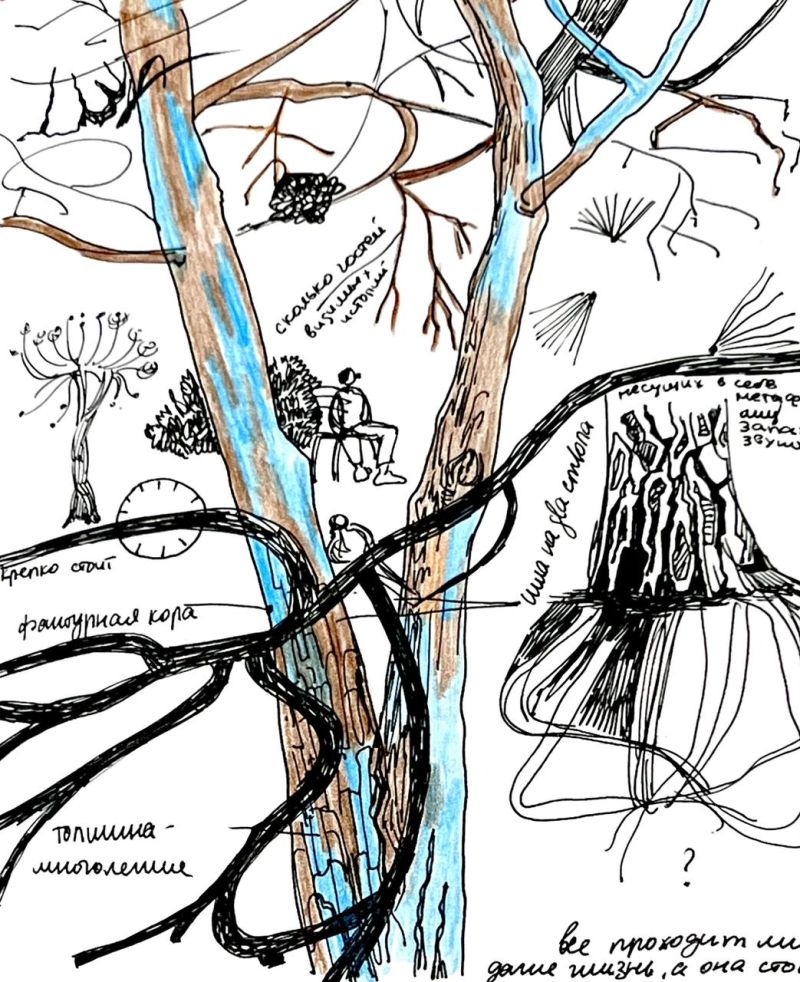
For Polina, an analog practice begins with touch. Working by hand means sensing the material, the surface, the behaviour of the tool, and sometimes the room itself. Drawing is her usual entry point, because it slows her down and makes abstract ideas visible. Materials for her are active participants of the process of thinking and making. Choice of the material is not random, it responds to her emotion, thought or idea and navigates her gesture, and design process.
For Melanie, digital is more than a technical category. She began with a dictionary definition of digital as information stored as electronic signals, then described digital worlds as a kind of parallel universe: artificial, human-made, connected to the physical world but with a different character, and full of opportunities to be someone else and to cross borders.
Both definitions were offered as starting points rather than settled answers, and the presenters invited participants to add their own views. The point was not to decide which kind of material counts, but to open a space to discuss how each one shapes what we see.
Polina Filippova
Polina: a tree as a lens
Polina’s T(r)ee project is a design research practice built around one tree. She walks to it, looks at it and draws it, and returns again and again. The project began on a walk, when a tree drew her attention and its branching shape seemed to mirror the branching futures she was imagining at the time. The question guiding the research was what meaning could emerge from a dialogue between herself and the tree, established through drawing.
Over time the archive grew beyond drawings. It came to include biomaterials, diagrams and moving images. Polina described the archive as a record of how meaning shifts with each return, and as something that emerged between her and the tree. Her main conclusion was that the research did not give her answers so much as changed the questions she could ask. Each return, she said, is never a repetition, but produces a new meaning.
Melanie: augmented presence and the body
Melanie works in speculative design, a discipline that imagines how the future might unfold in order to question present beliefs. Her master’s project in Digital Transformation, CTRL+ALT+Exist, is set in 2050 and imagines a state she calls augmented presence, in which physical and digital life merge so fully that a technology-augmented body feels normal. Identity in that world becomes a social and economic foundation, and the physical self can feel like a shadow of its digital version.
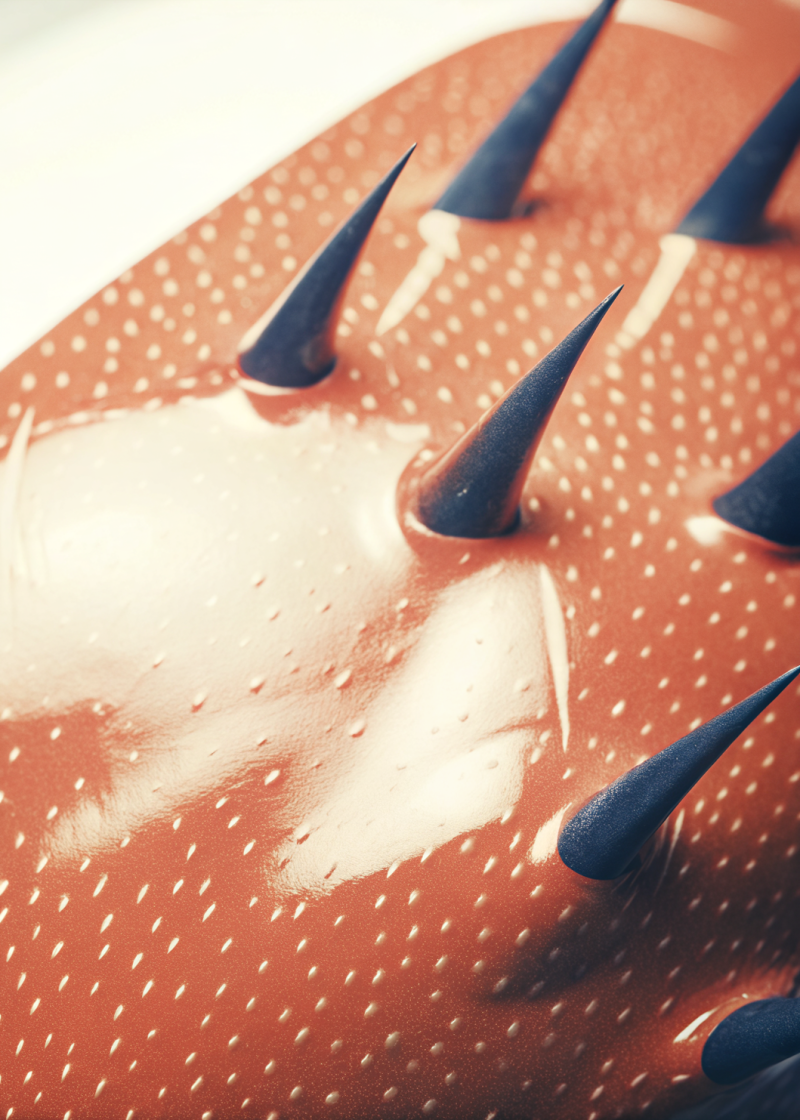
To ground the vision in research, Melanie drew on theories of online identity and social performance, which describe social life as a kind of play and digital identity as collective, shaped by cultural norms and power. Melanie created entities that communicate in unfamiliar, almost animalistic ways, through liquids, through hair that grows to give privacy, or through sound. Their visuals mix the artificial and the fleshy. Melanie described the project as neither utopian nor dystopian, because futures are rarely one or the other, and said it aims to ask what kind of digital future would be human-friendly rather than to answer that question.
Melanie Cieśliński
Building a material archive
After presenting their work, Melanie and Polina guided the participants through a collaborative workshop that the two developed together, based on their practices. Participants had thirty seconds to pick a material in the room around them and then share it in the chat or on camera Melanie and Polina define a “material” broadly: anything you interact with, from a pen to a notification sound to an abstract idea such as the colour blue. The more ordinary the material, the better it works for shifting perspective. The answers ranged from fabric, water and stone to a greeting card and a piece of chocolate.
The presenters then moved participants into two breakout rooms, one with each of them, to work with their chosen material. They worked with a digital tool to collect the participants’ answers on questions they prepared beforehand, to question their view on reality. Afterwards, both were struck by how much the answers could transform the material. Melanie noted that, reading the descriptions without knowing the materials, she often could not tell what had been picked. One participant said that the exercise seemed to bring the familiar object back as something strange, and that the practice of analyzing without any particular expectation was a way to provoke thoughts.
What we take from it
Melanie and Polina realized that, by working together on this project, their own views on their practices shifted. Materials, whether a tree, a bottle or a color, become a way of asking better questions when they are approached slowly, attentively, and repeatedly. Whether the object is drawn by hand or imagined in an augmented future, the workshop suggested that changing our perspective can change what we think is possible, and what questions we ask about what we see.
Polina Filippova
Melanie Cieśliński