Notes from “Ethical Dream-Weaving for Untameable Futures,” an experiment by and with Yuting Jiang and François Taddei at Untameable Futures (u+, 21-22 October 2026).
“Futures are untameable. We cannot predict or control them, so the question is how we navigate them together, when our dreams and our nightmares pull in different directions.” This was the starting point for the session, which introduced a method called “ethical dream-weaving” and a collective intelligence tool called Agora Citizen Network.
When one dream becomes another’s nightmare
François Taddei, co-founder and president of the Learning Planet Institute, explained that the session was meant to build visions together: of the futures we want, and of the ones we want to avoid. However, good intentions can produce harm. A dream that inspires some people can become a nightmare for others, and in an age when powerful technologies are within everyone’s reach, the question of how to dream ethically is no longer theoretical. It is a practical question.
What makes a dream ethical
The aim was not to find one shared dream. It was to look for dreams that are compatible: dreams that do not create nightmares for others. François offered an analogy with freedom. Your freedom stops where it infringes on someone else’s, and in the same way, an ethical dream stops where it infringes on someone else’s dreams and futures. A dream is most ethical when it is a nightmare for no one, today or tomorrow.
This means listening beyond the people in the room: to people who are not present, to future generations, and to other species. François noted that other species are unlikely to dream about plastic bags, but plastic can easily become their nightmare. The question becomes how we avoid polluting the oceans, for example, on behalf of those who cannot speak for themselves.
Weaving, not averaging
François used the metaphor of weaving. A single thread, a dream on its own, may be frail, uncertain or unstructured. But when threads are aligned with others and woven together, they form patterns and a more resilient structure, one that can help build a future we want together. Weaving does not mean erasing differences. It means finding the threads that hold them.
Mapping dreams with Agora Citizen Network
Yuting Jiang, co-founder and CEO of Agora Citizen Network, introduced the tool: an open-source collective intelligence platform that helps people map opinions and build consensus on complex issues. It has been used by institutions including UNESCO and by peacebuilding organisations.
Before the session, participants had shared their dreams and fears in a questionnaire. Agora turned these into fourteen statements extracted from the responses. They are not exact quotes, but attempts to capture each dream or fear and, in some cases, the tensions beneath it, such as those around market economies, capitalism, relationships with machines, and relationships between species. Participants responded to each statement by agreeing, disagreeing or saying they were unsure. The aim was to show where views align, where they collide, and which threads might bridge the differences.
By the end of the session, 34 people had cast 616 votes on 23 statements, nine of them written by participants during the session. Agora identified three opinion groups of similar size, labelled Ecosocialists, Humanists and Progressives.
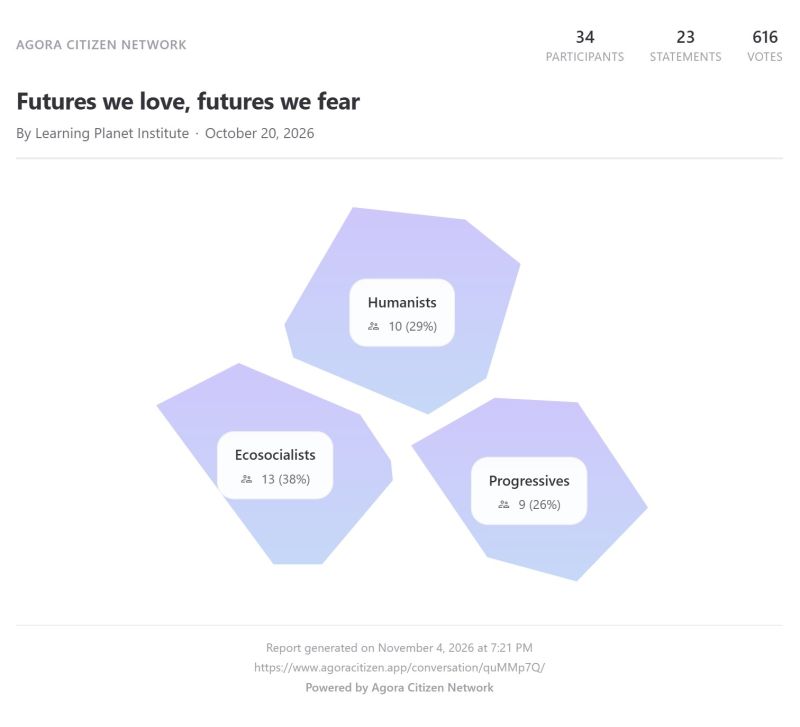
There was strong common ground. 91% agreed that tech billionaires hold too much political power, and that clean rivers and air for future generations should come before economic growth, with support of more than 90% in every group. Most also agreed that a good future requires moving beyond capitalism, and that they would accept slower technological progress if it protected our relationships.
The divisions were about the way forward: Humanists (10 people) worry most about technology weakening our ability to think, and value in-person connection over online connection; Progressives (9) are the most hopeful about technology and online connection. Ecosocialists (13) want to move beyond capitalism, give rights to nature, and embrace radical change.
Two statements written by participants won support across all three groups: “Imagination is infrastructure that can be built” and “In a desirable future, we can continue to strongly disagree on what a desirable future is.” The second sums up the session: weaving does not mean erasing differences.
What we take from it
The session offered a simple but demanding idea: a future worth having is one that does not depend on one person’s dream prevailing. Building it means mapping what we share, listening to those who are not in the room, and weaving our dreams together, so that more of us can live in the futures we are building.